
When a Verruca Just Won’t Go Away
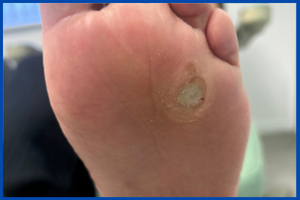 Why some verrucas resist treatment and what we can do next
If you’ve been treating the same verruca for months, or even years, you’re certainly not alone.
Verrucas can be incredibly stubborn. You may have tried pharmacy treatments, acids, freezing, filing or simply waited for it to disappear, only to find it is still there.
So why do some verrucas clear quickly while others refuse to budge?
 Why Are Verrucas So Stubborn?
Verrucas are caused by the human papillomavirus (HPV), which infects cells in the outer layers of the skin. In many cases, the immune system eventually recognises the virus and clears it naturally.
The difficulty is that HPV can be rather good at avoiding the body’s immune response. This means some verrucas can remain for a long time, particularly on the feet where pressure can also make them uncomfortable or painful.
When repeated treatments aren’t working, sometimes the answer isn’t simply more of the same. It may be time to consider a different approach.
 More Than One Way to Treat a Verruca
At Medipod Clinics, we offer a range of treatments depending on the size, location, duration and previous treatment history of the verruca.
Options include cryotherapy and Verrutop®, as well as more advanced treatments such as Swift® microwave therapy and laser therapy.
For particularly persistent verrucas, we can also consider minor surgical procedures including Falknor’s Needling, electrosurgery and surgical excision.
 When Needling Can Make the Difference
We’ve seen some excellent results with Falknor’s Needling, particularly in patients with stubborn verrucas that have failed to respond to previous treatments.
The procedure is performed under local anaesthetic. The verruca is punctured multiple times, introducing viral material into the deeper skin where it can be more readily recognised by the immune system. The aim is to encourage your own immune response to target the virus.
Needling is minimally invasive, usually requires relatively simple aftercare and can be particularly useful when other approaches haven’t been successful.
 What About Surgical Excision?
For selected, particularly resistant lesions, surgical excision may also be considered.
This is a deeper and more invasive procedure where the affected tissue is surgically removed under local anaesthetic. Sutures may be required, and healing and aftercare are generally more involved than with needling or electrosurgery.
For this reason, excision isn’t usually our first choice, but it can provide another option when clinically appropriate.
 There Is No One “Best” Verruca Treatment
Unfortunately, no treatment can guarantee that a verruca will disappear permanently. Even after successful treatment, verrucas can occasionally recur.
That’s why we don’t believe in a one-size-fits-all approach.
We assess the verruca, discuss what you’ve already tried and consider your medical history, lifestyle and preferences before recommending the most appropriate treatment options.
Still Have That Verruca?
If you’ve been treating the same verruca repeatedly without success, perhaps it’s time to stop fighting it with the same weapons.
Book a Verruca Consultation at Medipod Clinics and let us assess it properly, discuss the options available and create a treatment plan specifically for you.
Sometimes a stubborn verruca simply needs a different approach.
Thank you for reading this month’s blog – When a Verruca Just Won’t Go Away
Take care,
Faye Vogiatzoglou
Clinical Director, Medipod Clinics
September 2026 Blog
